

Though nomadic peoples left no written records, the metal artifacts, pottery, and horse tack they produced became key to deciphering their culture and beliefs. Moreover, lacking natural boundaries, the artifacts of these horse-riding nomads exhibited remarkable homogeneity across the Eurasian steppes, reflecting their similar lifestyles and natural environments. As quintessential equestrian peoples, these groups produced vast quantities of horse- and riding-related artifacts, often adorned with animal motifs such as wild goats, hedgehogs, deer, camels, griffins, and dragons. These motifs radiate both a fierce, aggressive energy and an alluring charm, perpetually brimming with vitality and life. This “animal style” became a major source of inspiration for decorative arts across Eurasia for centuries to come.
Through this article's analysis, readers can gain a clearer understanding of the innovations and contributions made by the nomadic peoples of northern China's grasslands in terms of material heritage, as well as their significant role in the history of Eurasian artistic exchange.
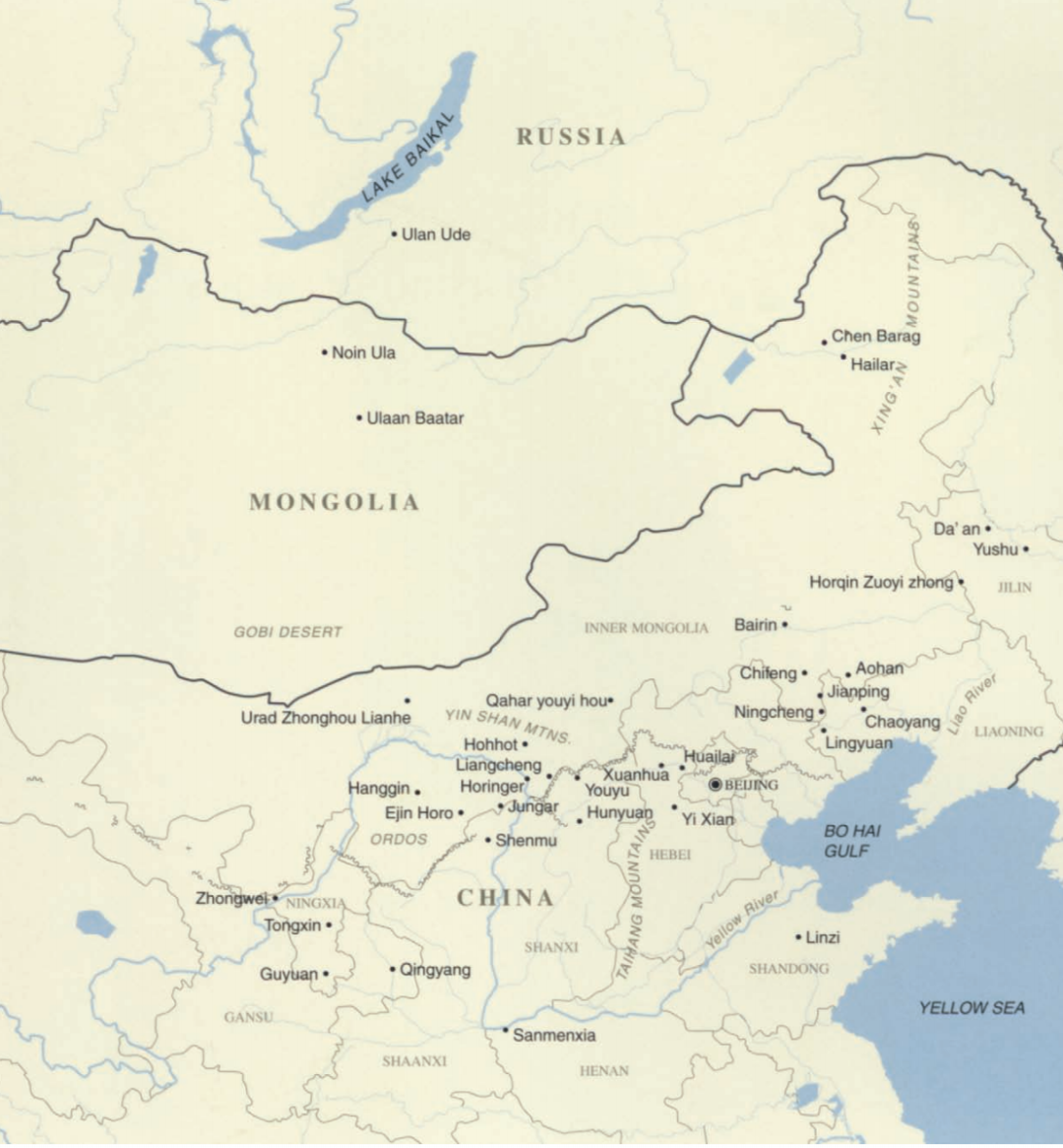
The northern border regions of the Eurasian steppe can be geographically divided into three cultural spheres.
Northeast China (hereinafter referred to as the Northeast Region)——Including the provinces of Jilin, Liaoning, and Heilongjiang, as well as southeastern Inner Mongolia—this region is home to agricultural and pastoral ethnic groups whose economies rely on animal husbandry, hunting, and agriculture. The area boasts fertile land, numerous rivers, favorable irrigation conditions, and minimal seasonal migration.
Northern Hebei Province (hereinafter referred to as the Northern Hebei Region)The group primarily hunted, supplying animal products such as furs to their southern neighbors in China, and did not need to undertake long-distance migrations.
The vast region west of the Taihang Mountains (hereinafter referred to as the Northwest Region)——Covering northern Shanxi, Shaanxi, southwestern Inner Mongolia, Ningxia, southeastern Gansu, and parts of Xinjiang—their economies were based on extensive grazing and livestock trade, necessitating seasonal migrations in search of pastures and fresh water. Though culturally and technologically interconnected, their material remains exhibit distinct characteristics.
Northeast Region
Artifacts from the Northeast region predominantly feature realistic animal depictions and hunting scenes. Metal objects were primarily produced using block mold casting techniques, with the most distinctive handicrafts being knives, daggers, helmets, chariot and horse fittings, and small personal ornaments—including belt decorations—alongside tools suited for settled agricultural, pastoral, and hunting cultures. Among these, chariot and horse ornaments adorned with hunting scenes represent a signature product of the Northeast region.

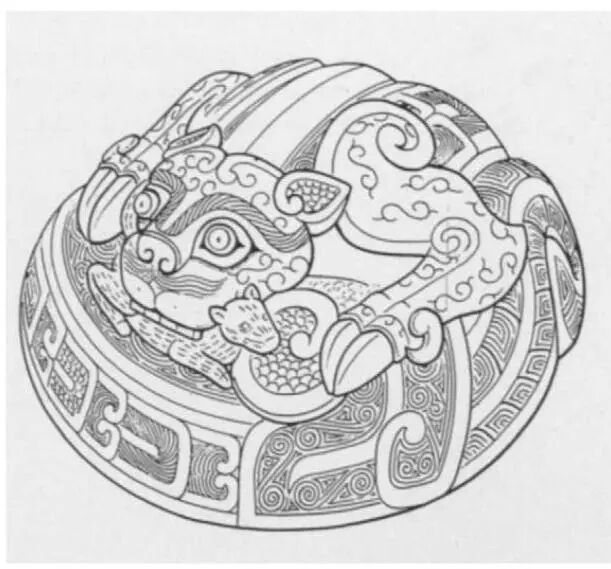
Bronze fittings from a mounted rabbit hunter unearthed from Tomb No. 3 at Nanshangen, Ningcheng, Inner Mongolia. 8th century BC.
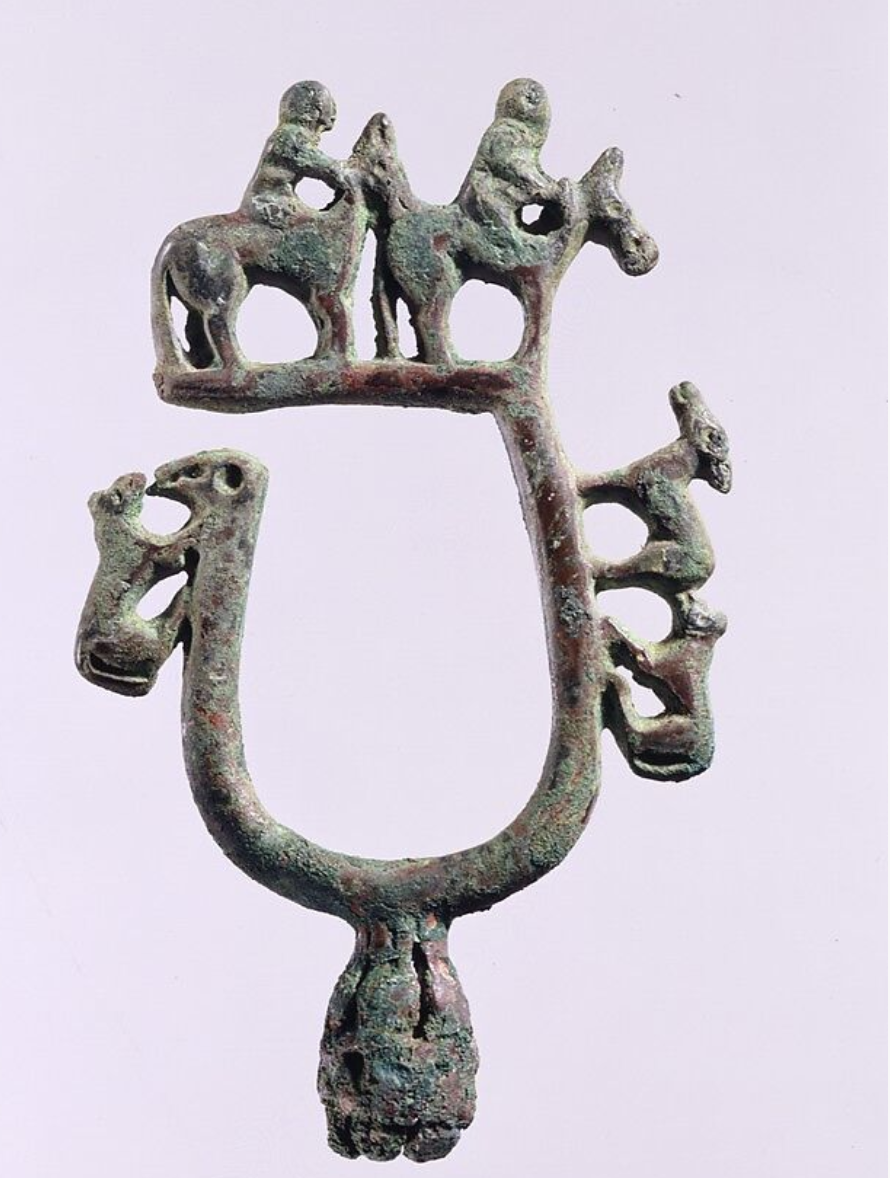
Horseback Hunter's Tack
Northeast China, 7th to 6th century BC
Source: Formerly in the collection of Lan Lijie
In the scene, two mounted hunters accompanied by a dog are driving a doe toward them. The circular image runs along the edge of a bronze horse harness ornament featuring a pendulous openwork bell. On the opposite side, another hound faces the head of a bird of prey. A small stone appears embedded within the bell. This ornament was cast using the indirect lost-wax method, wherein the wax model was formed within a two-part mold.
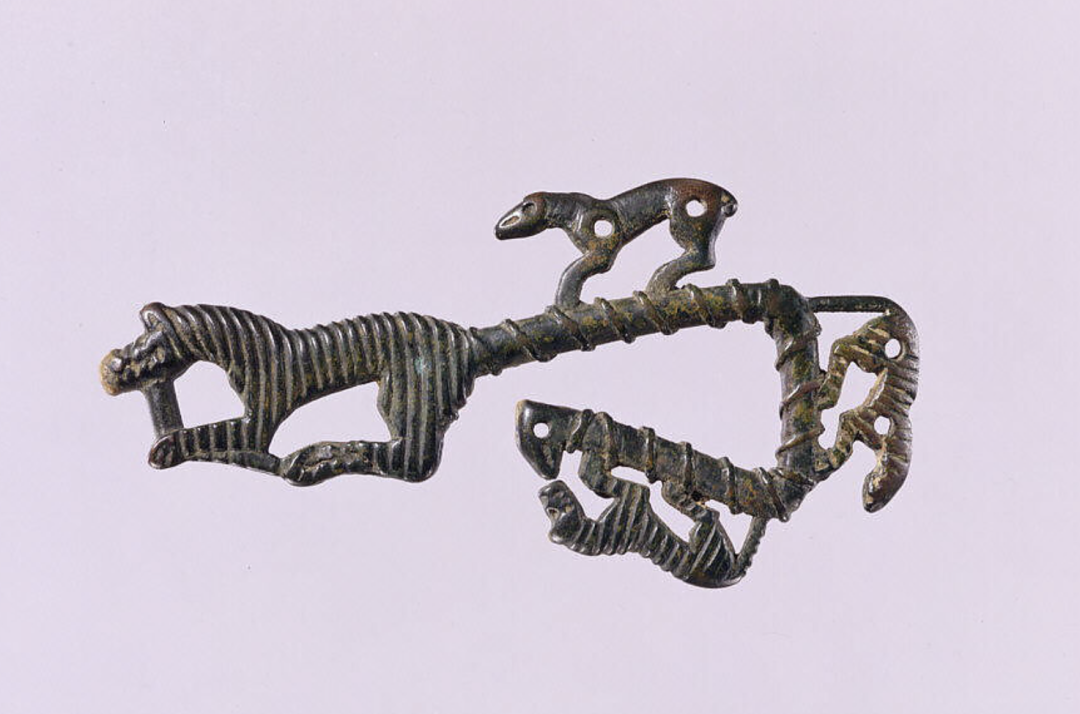
7th–6th Century BC
This hook-shaped horse harness ornament depicts a tiger whose long tail terminates in a stylized bird's head. A doe and two additional felines are rendered along the tail, which serves as the ground line and forms the hook. Ribbed lines representing stripes mark the tiger's fur, while the doe's body remains undecorated. A connecting rod linking the tiger's lower jaw to its foot serves as the suspension ring. Cast using the lost-wax method with a two-part mold, the ornament's raised spiral pattern encircling the tail may have been formed by winding cord around the wax mold.

This hollow-cast horse harness ornament depicts a reclining tiger with exposed, jagged fangs and a long, elegantly curved tail bearing a bell containing small stones. Concentric indentations mark the tiger's shoulders and hindquarters, while two rows of faux pearls adorn the tail's length. Wear marks are visible within the circular suspension ring extending from the tiger's forepaw. A mold seam running the full length of the tail indicates this object was cast using the indirect lost-wax method, wherein the wax model was formed within a two-part mold.
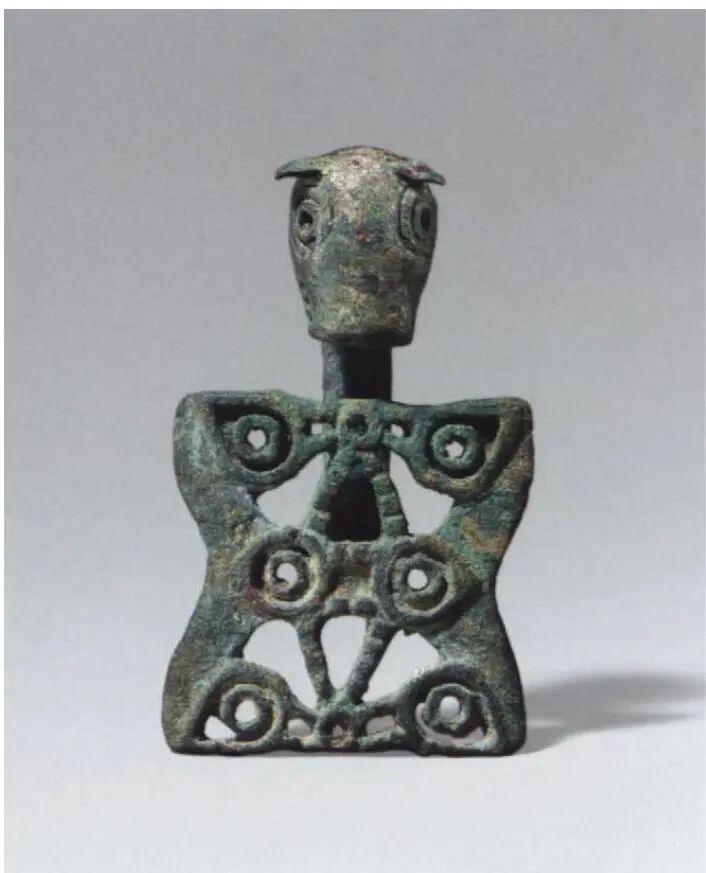
Animal Head Horse Tack Bell
Northeast China, 7th to 6th century BC
This bell is shaped like a hollow, circular animal head. It is attached beneath a flat, openwork panel depicting two mirrored animal heads joined at the shoulders. The eyes of both the animal heads and the head-pattern motifs are indicated by circular perforations within raised borders, while each motif's shoulders are marked by a perforation centered within a raised teardrop-shaped border. The bell's three-dimensional form and absence of casting marks suggest this accessory was produced using the lost-wax casting technique.

Rubbing of a bronze decorative plaque discovered near Chifeng in southeastern Inner Mongolia

Mongolian Wild Ass
Gold
Source: Formerly in the collection of Lan Lijie
This gold ornamental plate depicts a standing male kulan, symbolizing the wearer's status as a badge worn on the chest. The kulan is rendered in profile, depicted with only two legs, though both ears are rendered, with the mane indicated by raised striations. Its identity is confirmed by the oversized ears and the tassel at the tail's end. The reverse features two vertical V-shaped rings for attachment, one behind the muzzle and the other behind the hindquarters. The panel's edges are notably uneven, suggesting casting from a two-piece mold. It shows minimal cleaning, with traces of red cinnabar from the burial ritual still visible on the head. The tail appears to have been reattached in antiquity, as this is not a recent repair.

Belt buckle featuring animal combat scenes
Northern China 3rd to 2nd century BC
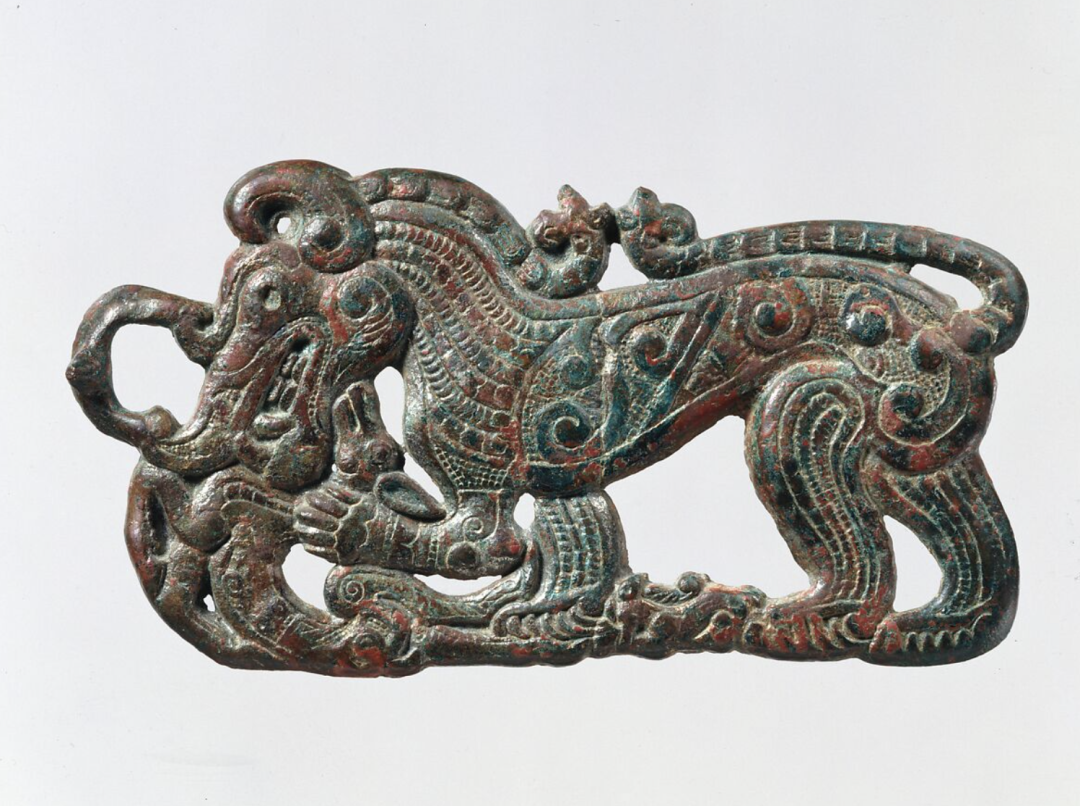
Wolf-Patterned Bronze Belt Fittings
Northern China 4th century BC
Northern Hebei Region
The material culture of the hunting peoples inhabiting the rugged Jundu and Yin Mountains in northern Hebei Province differed markedly from that of the northeastern region. Burial artifacts such as ceremonial canopies, horse tack fittings, daggers, knives, personal ornaments, tools, and other utilitarian items were adorned with zoomorphic motifs—drawing inspiration from the local fauna including leopards, deer, ibex, gazelles, snakes, frogs, and birds.
In northern Hebei, the most distinctive handmade artifacts of these ethnic groups are breastplates. These breastplates often carried class distinctions, with higher-ranking individuals wearing gold breastplates, some of which were inlaid with turquoise (mostly lost today). The designs of the breastplates also appear to reflect gender differences: men predominantly wore breastplates featuring leopard motifs, while women preferred designs depicting frogs encircled by snakes, possibly symbolizing fertility.

Snake-and-Frog-Shaped Brooch
Northern Hebei Province, 6th to 5th century BC

Leopard-shaped breastplate
Source: Joseph G. Gerena Fine Art, New York
This gold breastplate depicts a leopard crouching in profile. Turquoise inlays once marked the tip of the tail, shoulders, hips, paws, eyes, and mouth, though only two inlays remain today. A short support rod connects the tail to the hind legs. The reverse is hollow, featuring two vertical connecting rings—one behind the neck and another behind the hindquarters. The panel was cast using the lost-wax method. The rear legs and tail were previously broken off but have recently been reattached.
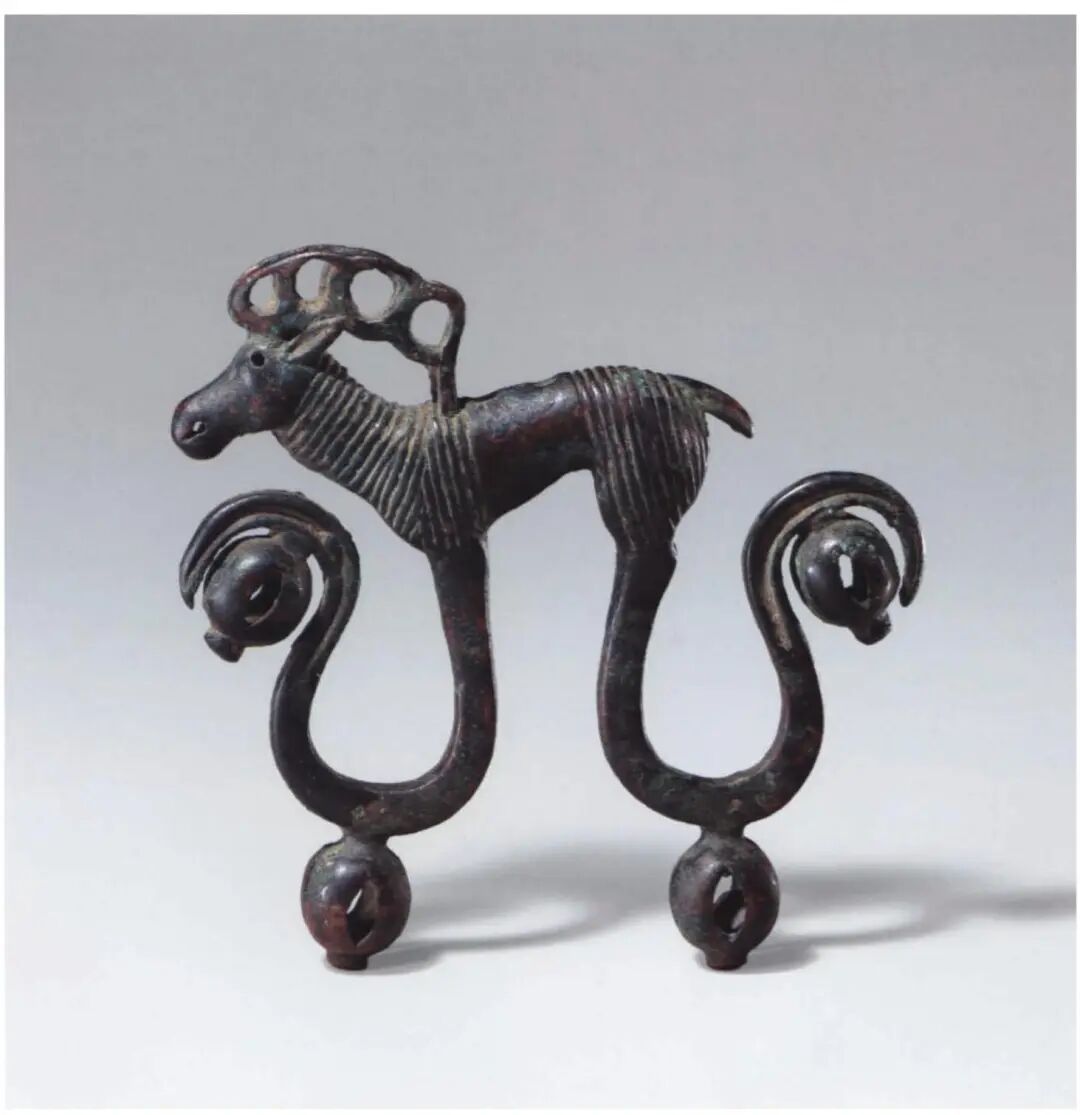
Another distinctive type of artifact craftsmanship involves bronze finials cast using the lost-wax method, featuring standing animals atop them. Similar bronze finials cast by the lost-wax method, bearing standing wild sheep on their tops, have been discovered in southern Siberia dating from the 7th to 6th centuries BCE. These finials were used to adorn the corner posts of canopies placed above coffins during funeral ceremonies.

Bronze canopy decoration from Arzan, Tuva Republic, Southern Siberia. 7th–6th century BC
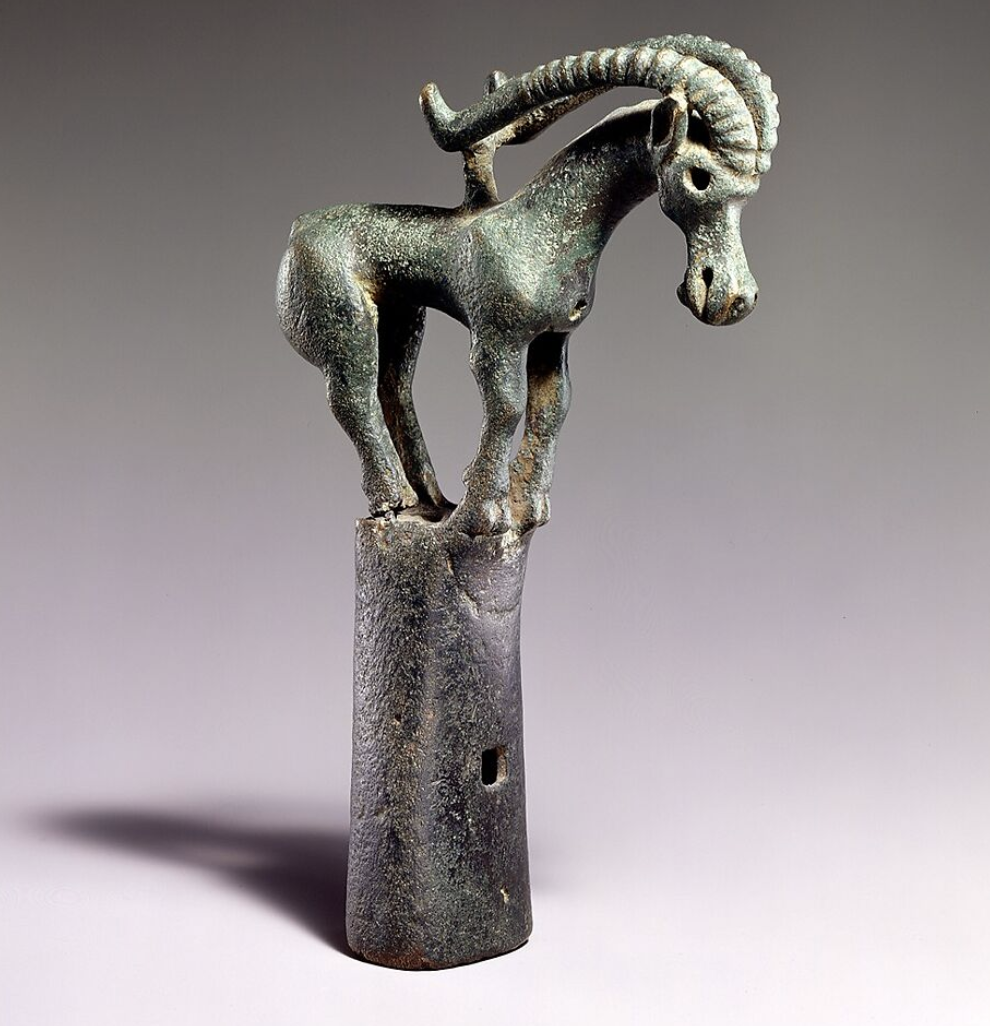
A pointed ornament featuring a standing wild goat
Northern China, Hebei Province, 7th–6th century BC, Bronze Age
Source: Formerly in the collection of Lan Lijie
This finial depicts a standing bighorn sheep with prominent horns and clasped hooves. The tips of its ears are broken off, and remnants of a beard are visible beneath the jaw. The horns curve backward over the neck, supported by a pillar extending to the shoulders. The sculpture is hollow, cast in the round, with an elliptical socket running through front to back for mounting. The absence of mold seams indicates this finial was produced using the lost-wax casting technique.

Four ram-shaped finials
Northern China, Hebei Province, 7th to 6th century BC
Source: R. H. Ellsworth, Ltd., New York
These four finials, which once adorned the corners of the ceremonial canopy used in funeral rites, each feature a standing wild ram with large curved horns. The ram's eyes are indicated by perforations with edges extending through to the opposite side, while the horns are marked by ridges along their front edges. The two taller finials on the right each have a ring on opposite sides of their sockets, while the two shorter finials on the left feature a single ring on the back of their sockets and two holes on each side. Some sockets still retain remnants of the objects to which they were attached. These finials appear to be made of an extremely dense alloy, with no mold marks detected, suggesting they were cast using the lost-wax method.
Additionally, small arms, particularly daggers, feature prominently among burial goods in Hebei tombs. These were found fastened to the deceased's waist on belts, an essential item in a hunter's toolkit. Daggers from northern Hebei sometimes bear a raised central ridge along the blade—a reinforcement mechanism.
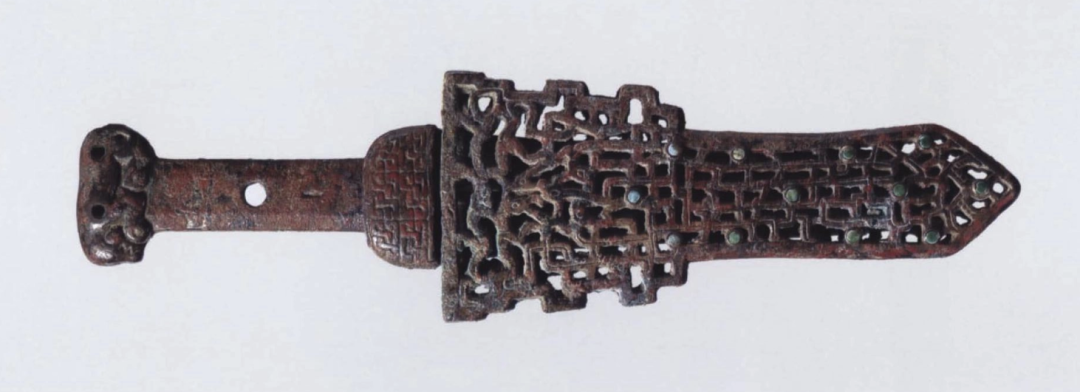
Short sword and scabbard featuring a crouching feline
Hebei Province, Northern China, circa 6th century BC
A three-dimensional feline crouches atop the hilt of this elegant dagger. The flat, rounded handle features a central perforation for suspension, while the guard is adorned with an interlaced pattern. The slender, tapering blade features a rounded central ridge extending from the base of the guard. Serrated, undulating lines represent the feline's sharp teeth, while circular indentations mark the shoulders and hips. The blade and hilt are cast as a single piece, with visible mold seams along the edges.
Northwest Region
The Northwest region can be further subdivided into three distinct areas based on significant differences in material remains. First is the region west of the Taihang Mountains in central and southern Inner Mongolia, including parts of northern Shanxi. Second is the area centered farther west of the Ordos Desert, encompassing northern Shaanxi. Finally, the region comprising southern Ningxia and southeastern Gansu, centered around the vicinity of Guyuan and the Qingyang Plateau.

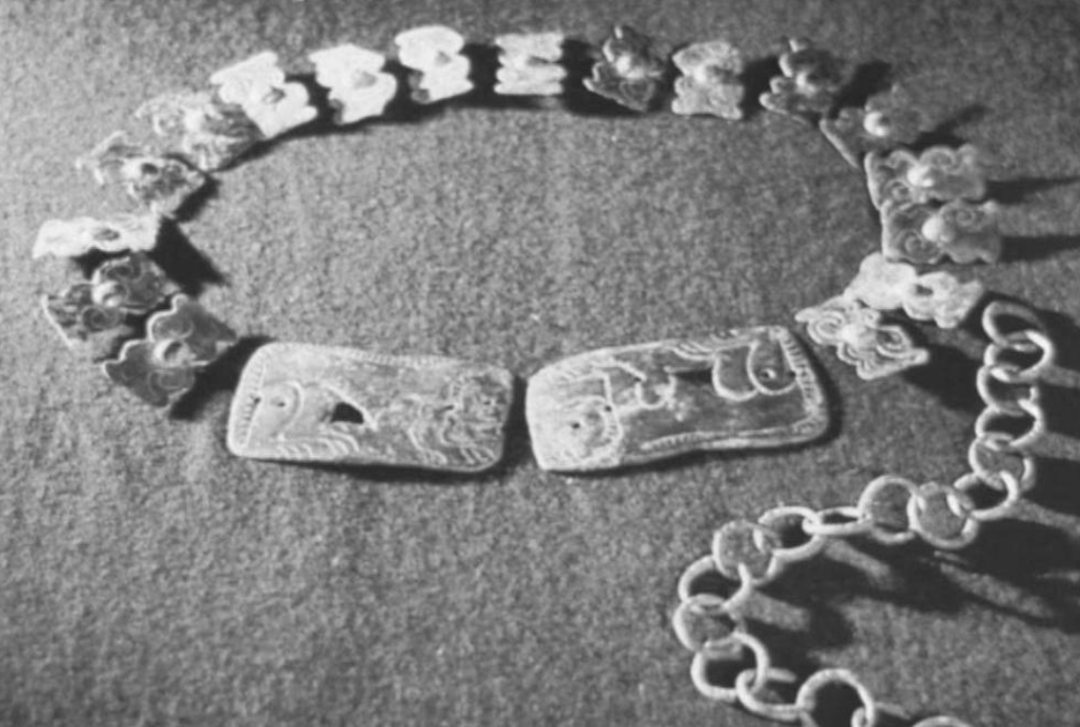
A belt with tin-plated copper plaques unearthed from Tomb No. 5 at Maoqinggou, Liangcheng County, Inner Mongolia. 6th–5th century BC.
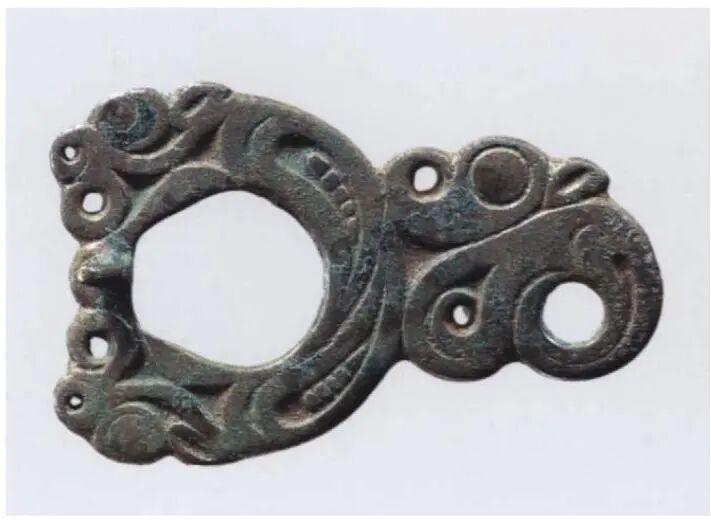
Northern China and Central-Southern Inner Mongolia 6th–5th centuries BC Tin-plated bronze
Source: Joseph G. Gerena Fine Art, New York

Two yoke ornaments shaped like recumbent rams
Northwest China and Southwest Inner Mongolia, 5th to 4th century BC
These two recumbent rams with folded legs were hollow-cast to fit over the circular yokes on either side of a two-wheeled cart's drawbar (see also no. 32). Their legs are intertwined, with hind hooves pointing downward and front hooves upward. Each ram has its mouth open and tongue extended. A longitudinal casting line between the horns bisects each ram's body, indicating segmented mold casting. Casting lines along the horn edges suggest they were cast separately and then welded on.
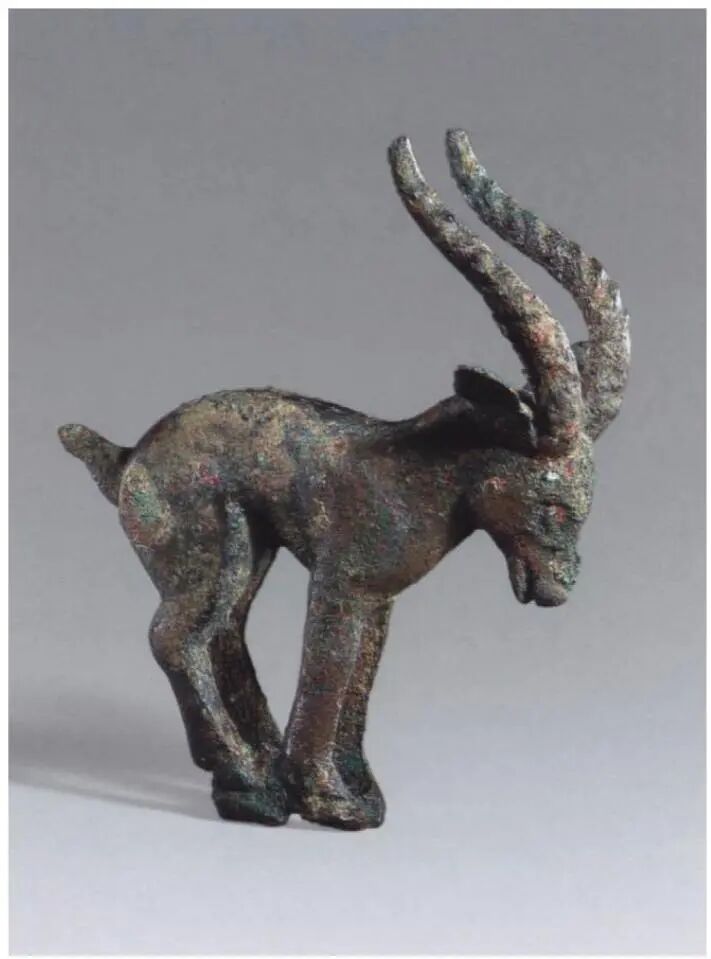
Antelope-shaped finial
Northwest China and Southwest Inner Mongolia 5th to 4th century BC
Source: Formerly in the collection of Lan Lijie
A finely crafted antelope crouches with its legs drawn up, standing on the remnants of a damaged socket. The antelope features almond-shaped eyes formed by indented lines and a slightly parted mouth. A longitudinal mold line, particularly noticeable beneath the jaw, indicates it was cast in sections.
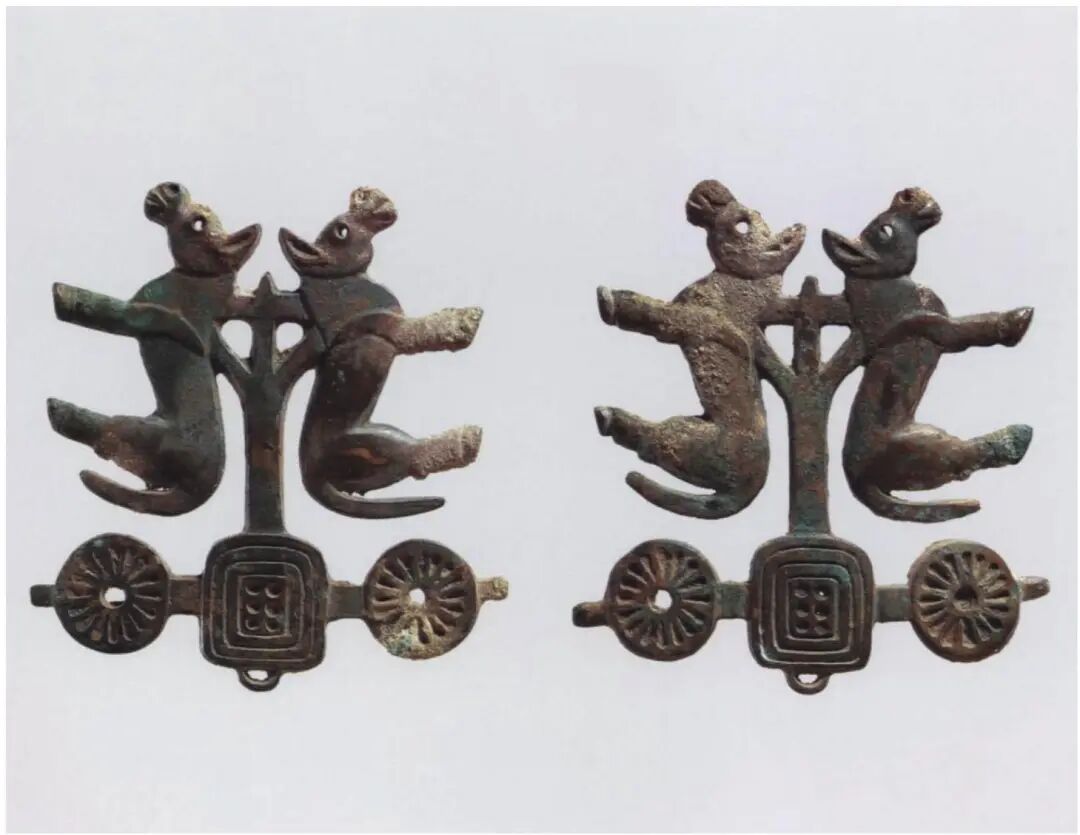
Four ram-shaped finials
Source: R. H. Ellsworth, Ltd., New York
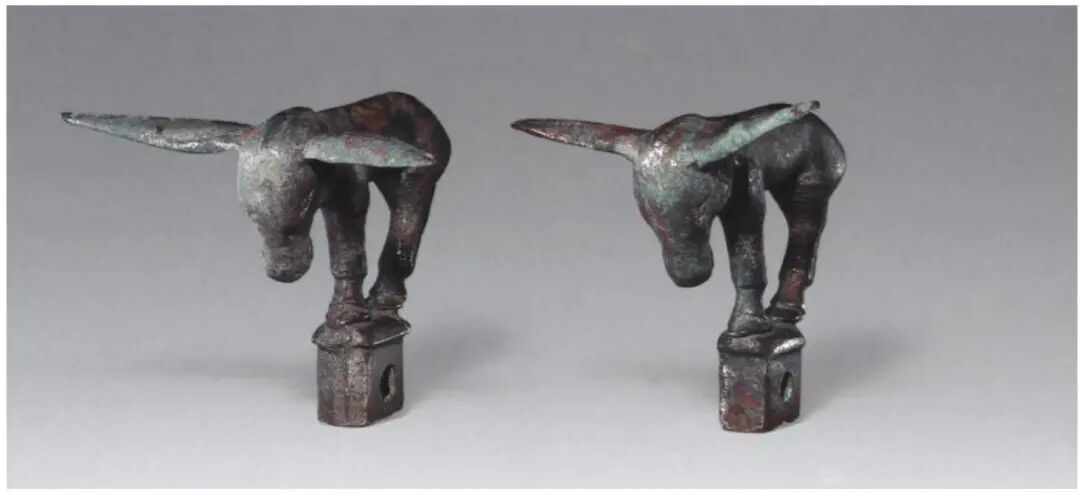
This pair of finials may have once adorned a funeral carriage. The oversized ears indicate these animals are wild horses, common on the grasslands of China's northern frontier. Each horse is sculpted in the round, though its front and hind legs are fused into a single piece. The eyes are naturally rendered through recessed areas, and each horse's mouth is slightly open. The mounting holes are rectangular, each featuring two holes for inserting fixing pins. The lustrous surface of the bronze indicates the finials were deliberately tin-plated, while a longitudinal seam confirms each finial was cast using a segmented mold.

Deer-shaped yoke ornament
Northwest China and Southwest Inner Mongolia Approximately 4th century BCE
Source: Formerly in the collection of Lan Lijie
This standing doe originally belonged to a chariot decoration. It features almond-shaped eyes indicated by incised lines and an open mouth. The feet are connected by a horizontal band that serves as a base line, accentuating the slender legs. The statue was cast hollow, retaining some casting cores. Traces of red cinnabar are visible on the face.

Golden Head Ornament from Nalin Gaotu, Shenmu County, Shaanxi Province, Late 4th Century BC
Some animals depicted on the yoke ornament are in a reclining posture, which differs significantly from the depictions of hoofed animals on artifacts from the Northeast region, where the latter appear to be running. In the Ordos region, the reclining animal is a red deer. Its legs are crossed, with the soles of the front hooves facing upward and those of the hind hooves downward. This posture originates from the artistic traditions of the Qin state and can be traced back to the Shang dynasty. Furthermore, this distinctive depiction of hooves also appears in contexts from the Black Sea region during the 5th century BCE.
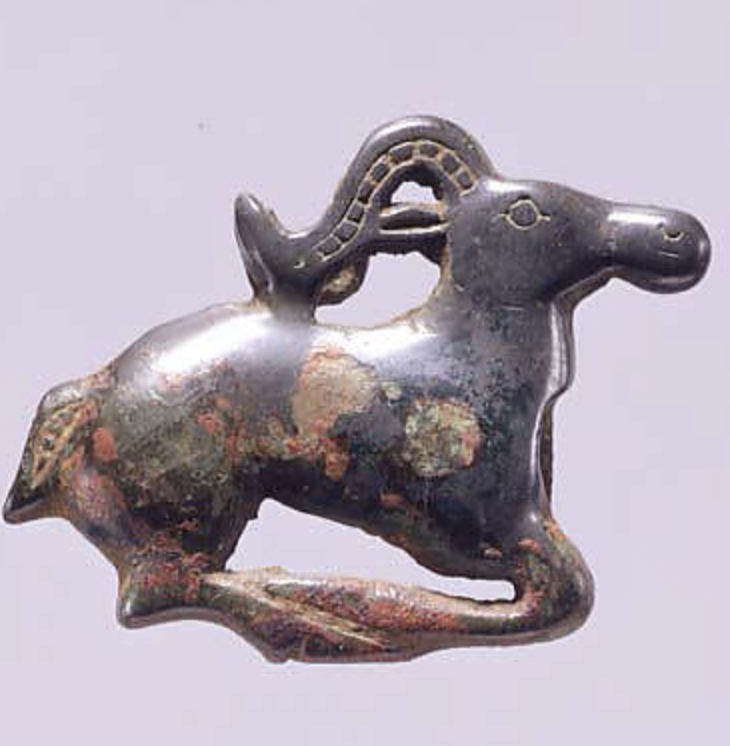
Gazelle-shaped horse tack ornament
Northeast Region 6th–5th centuries BC

Gazelle-shaped horse tack ornament
Northeast Region 6th–5th centuries BC
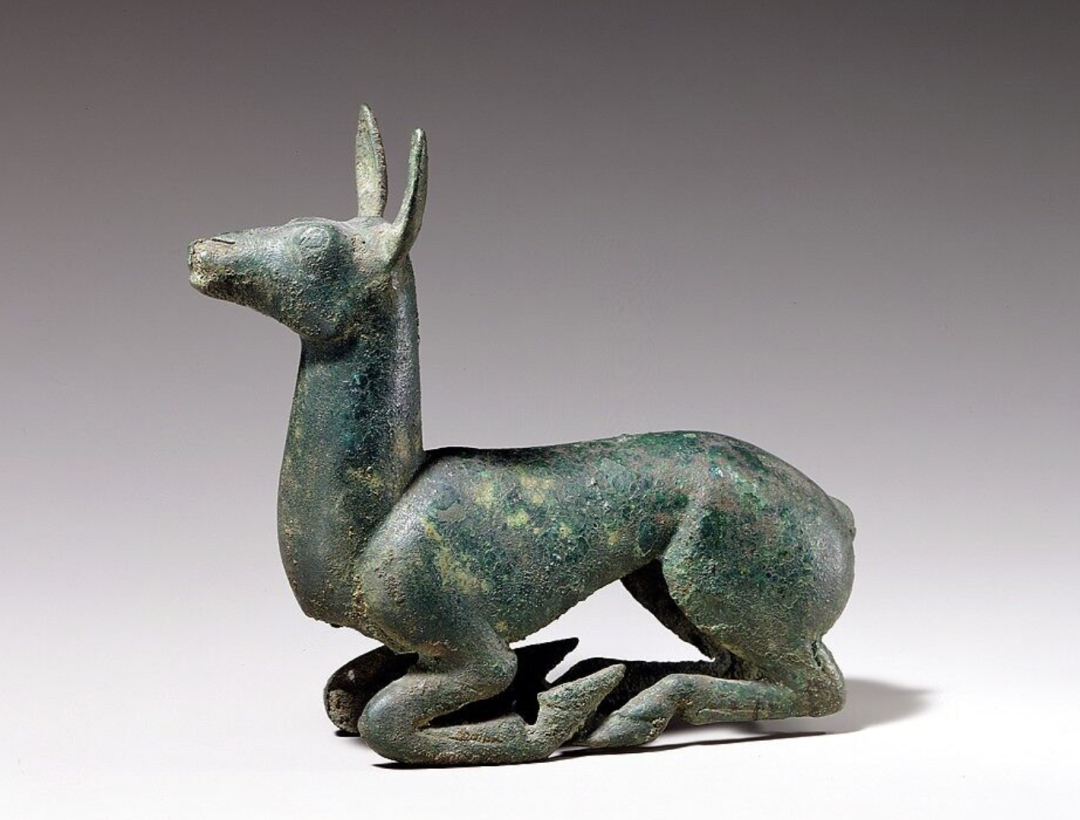
Bronze Chariot Ornament with Reclining Deer Design
Northwest China and Southwest Inner Mongolia, 5th to 4th century BC

Ram-headed chariot yoke ornament
Northwest China and Southwest Inner Mongolia 4th century BC
Source: Lan Lijie
This intricately crafted ram's head was used to adorn the end of a wheeled vehicle's drawbar. The ram's tongue protrudes, and its distinctive ridged horns curl around the ears. A small ring is positioned beneath the ram's jaw. Hollow-cast, the sculpture features an open socket at its tip for insertion into the axle end, with two open rectangular slots at the base likely for securing. A longitudinal mold line, particularly visible beneath the tongue, indicates the head and body were cast in separate sections; the horns were cast individually, then inserted into the head's socket and welded in place.
Southern Ningxia and southeastern Gansu
Compared to the Ordos region, the artifacts of nomadic peoples in southern Ningxia and southeastern Gansu exhibit highly complex cultural hybridity. Burial goods include harness ornaments, horse tack fittings, and large, exquisitely crafted belt buckles featuring diverse styles, casting techniques, and animal motifs. Animal-shaped yoke ornaments are common in burials. Typologically, a minor distinction exists between those from southern Ningxia and southeastern Gansu and those from the Ordos region: the cast animal mouths on the former are open.
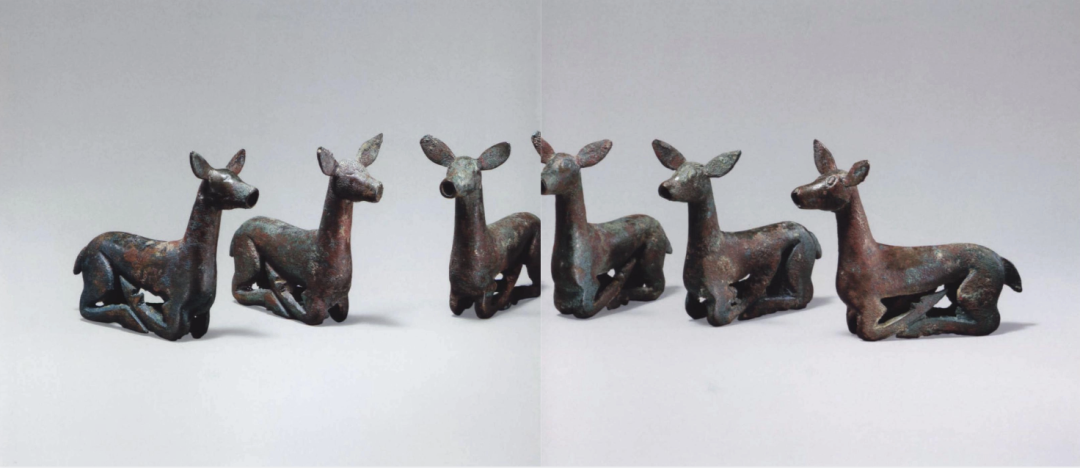
A set of six yoke ornaments shaped like reclining does
Northwest China, Ningxia and Gansu, 5th–4th century BC
These six alert reclining doe statues feature upright heads and legs folded beneath their bodies. Their hollow bodies were designed to fit over the circular yoke of a two-wheeled vehicle used in funerary rituals. The leg posture matches that of statues numbered 31 and 35, but the open muzzle section was cast differently. These sculptures are characterized by intricate mold marks. One mark bisects the body longitudinally, while others appear on the backs of the ears from the base to the tips, indicating each doe was cast as a single piece with its ears in multiple molds.

A Pair of Reclining Deer-Shaped Yoke Ornaments
Northwest China, Ningxia and Gansu, 5th–4th centuries BC. Tin-plated bronze
These two yoke ornaments are cast in the shapes of a doe and a stag. The stag's antlers are now missing from the slot between its ears. Both deer feature eyes rendered as small almond-shaped protrusions and mouths as open slits. Hollow castings with openings at the muzzle and nose, these ornaments contained internal cores. Despite significant surface wear, traces of the tin plating remain visible beneath corrosion. A longitudinal mold line bisects the body, while a V-shaped mold mark beneath the ears indicates each deer was cast as a single piece, including the ears.
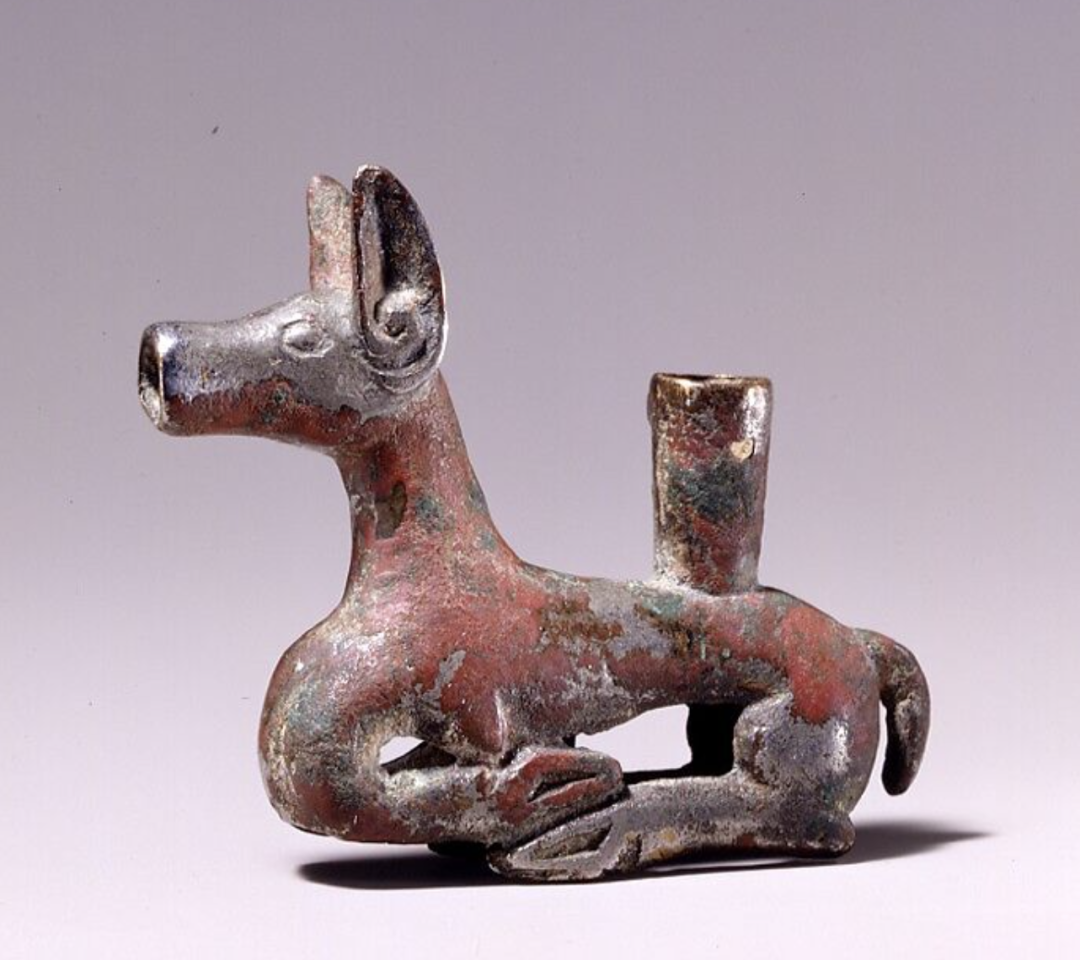
Deer-shaped yoke ornament
Northwest China, Ningxia or Gansu, 5th–4th century BCE. Tin-plated bronze.
Like all yoke ornaments, this reclining doe was cast hollow. A sunken almond-shaped mark indicates each eye, while each ear is represented by a triangle originating from a spiral line at the inner base. A vertical slot protrudes from the back, likely once used to secure a banner or tassel. The object has been rubbed with molten tin, giving it a shiny silver appearance. A longitudinal mold line bisects the entire figure, including the slot.
Additionally, the horse tack fittings and belt plaques from southern Ningxia and southeastern Gansu differ markedly from the burial goods found in tombs of the Ordos region. The horse tack accessories primarily consist of small rein fittings and larger decorative plaques.

Horse tack fittings featuring animal motifs
Northwest China, 5th to 4th century BC
Source: Formerly in the collection of Lan Lijie; Calon da Collection
This equestrian ornament features an unusual combination of animal motifs rendered in relief. The upper section depicts a coiled carnivore, with one front paw and one hind paw visible from the front, as if viewed from above. A curved element hangs below, featuring a bird's head with ears at one end and another bird's head with a curved, elongated beak at the other. The hollow reverse of the panel bears two square vertical rings, formed in the same manner as Exhibit No. 7 (a coiled wolf-shaped ornament), indicating this piece was cast using the lost-wax technique.
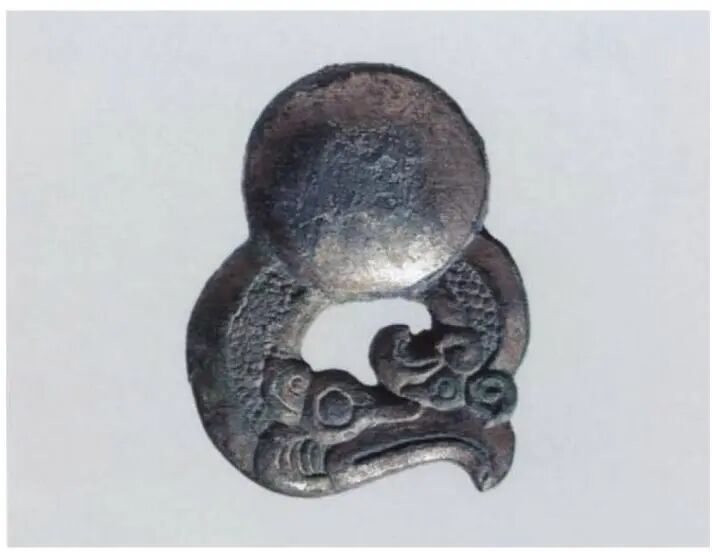
Horse harness ornament with a bird-head-shaped terminal
Northwest China, 4th century BC Tin-plated bronze
Source: Michael Dunn, New York
This equestrian ornament is cast in the shape of a circular boss, from which hangs a curved element terminating in a bird's head. One bird appears slightly fierce, with a short, curved beak, round eyes, and prominent ears; the other features a longer, hooked beak and smaller ears. The front of the ornament is tin-plated to give it a silvery appearance. A central band with a pebble-like texture serves as the curved element connecting the two birds' necks. A vertical ring is positioned behind the hollow pedestal, with casting marks indicating this component was cast as a single piece with the ring.
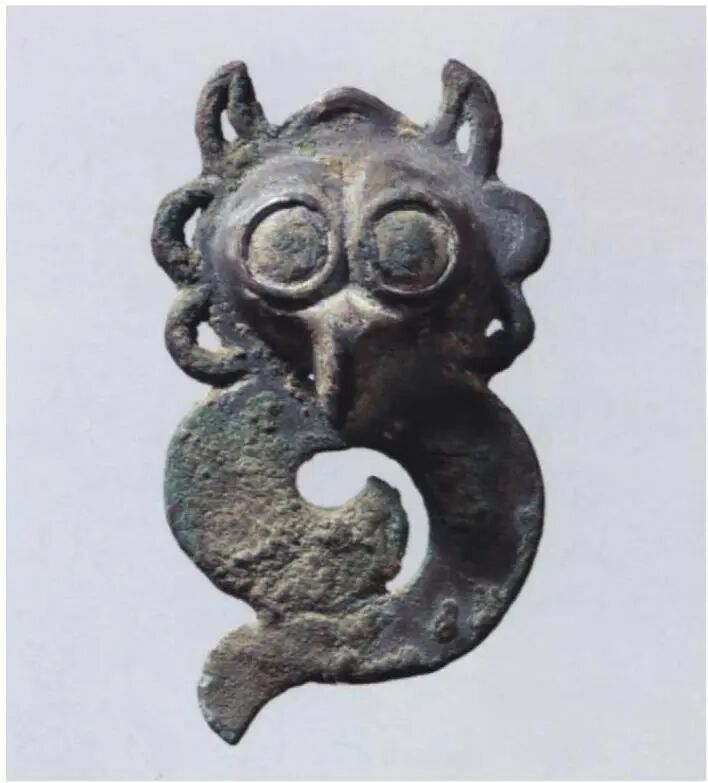
Tin-plated bronze
Provenance: Michael Dunn, New York
This horse harness ornament depicts a stylized owl head holding a coiled bird in its beak. The owl's protruding eyes are formed by a raised platform within a convex circular rim, while the neck feathers are represented by two openwork rings beneath pointed ear tufts. The pendant bird is highly abstract and recognizable only when compared to earlier versions (e.g., No. II). Tin-plating traces around the eyes indicate surface treatment. The reverse features a seemingly crude vertical ring within the hollow owl head. Burrs at the opening suggest the ornament was cast using a sheet mold.
Large belt buckles depict a standing carnivore tearing into an injured herbivore. These buckles were cast in mirrored pairs and often tin-plated to achieve a bright silver surface. Such belt buckles first appeared in the Tagar culture of Minusinsk, Siberia, and were also found among nomadic groups in the Altai Mountains. This indicates long-distance trade links between Minusinsk, the Altai Mountains, and Guyuan-Qingyang, while similar buckles did not appear near Ordos during the same period.
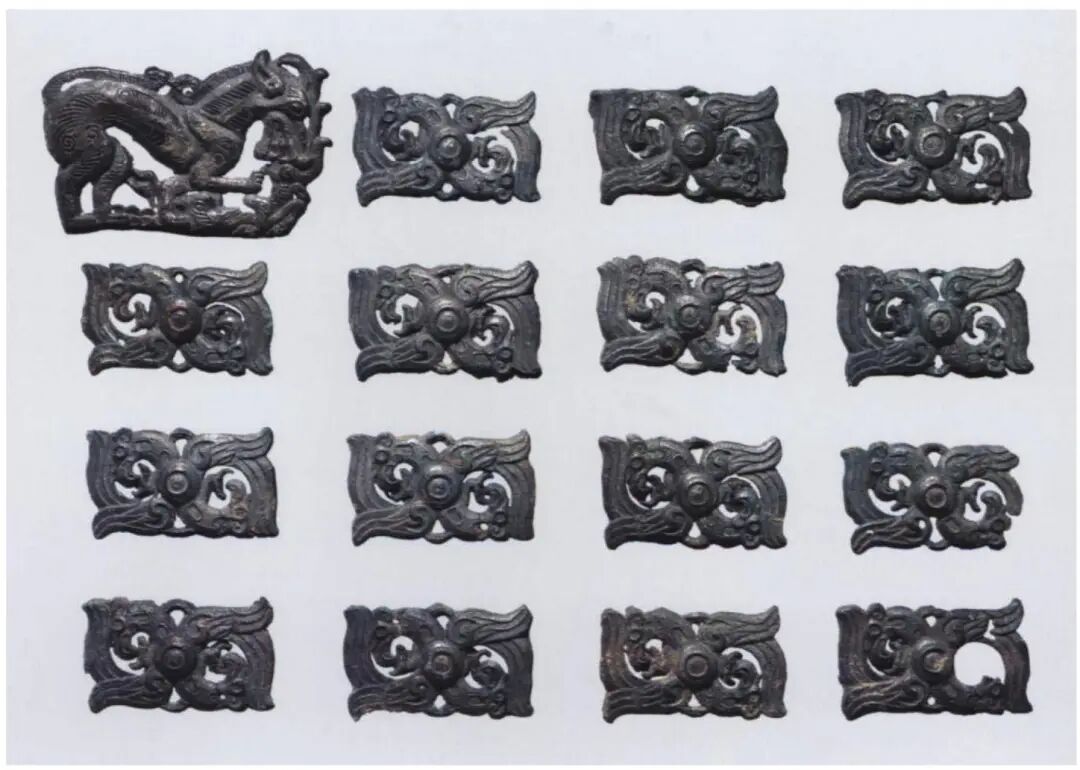
Northwest China, 4th century BC Tin-plated bronze
Provenance: Michael Dunn, New York
This section of a sixteen-piece belt ornament set comprises a buckle plate and fifteen smaller plates. The large plate depicts a fantastical standing wolf tearing at a fallen deer. It forms the right-hand half of a pair of mirrored plates that would have joined to create a complete belt buckle. The ears are heart-shaped, while the tail and crest ends feature eared raptor heads. Below the wolf lie three fan-shaped elements, remnants of a pup figure similar to those beneath the carnivore in item 94. The deer lies with its twisted body, muzzle within the wolf's open jaws. The reverse features a vertical ring behind the wolf's hindquarters, with another ring fragment behind its head. This panel was cast using the lost-wax method, then intentionally tin-plated on one side to achieve a polished, lustrous surface.
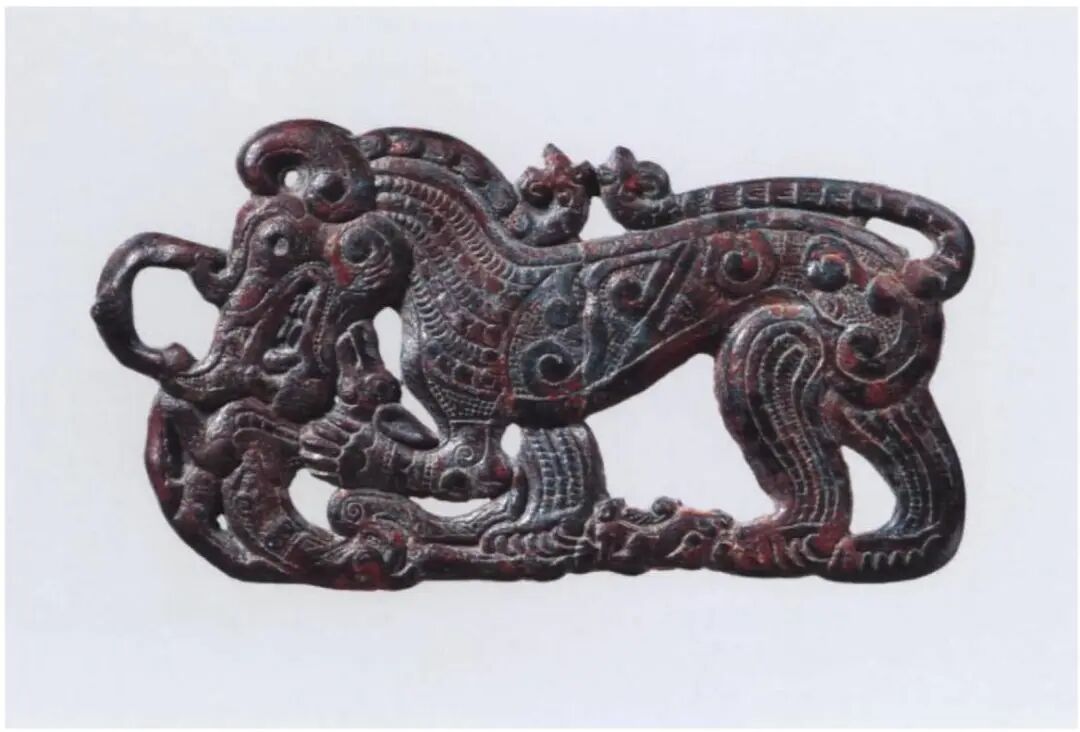
Northwest China, 4th century BC Tin-plated bronze
Provenance: Formerly in the collection of Lan Lijie
This bronze belt ornament depicts a standing wolf poised to strike a doe, its raised left forepaw clutching the animal. The doe's head lies beneath the wolf's open jaws, revealing four teeth and two fangs poised to sink into the doe's tender flesh. The doe's hindquarters twist 180 degrees beneath the wolf's left forepaw. A wolf cub appears on the ground line between the wolf's front and hind legs. The wolf's ears are uniquely comma-shaped, and its fur features various linear patterns including woven bands, scrolls, dots, and scales. Both the crest and tail tip feature the heads of eared birds of prey. Shiny patches throughout indicate the object was intentionally tin-plated. A ring with a protruding hook tangents the wolf's muzzle, while a vertical ring rests behind the hindquarters. Thick flanges visible on the plaque's reverse indicate it was cast using the indirect lost-wax method. In certain areas, the junctions between sections of the wax mold remain discernible. It is also apparent that the opening in the plaque was carved through from the front of the wax mold.

Northwest China, 5th–4th century BC
Tin-plated bronze
Provenance: Formerly in the collection of Lan Lijie; Calon da Collection
This pentagonal buckle features a twisting figure surrounded by narrow-edged scale-like decoration. A large dragon mask with typical Chinese heart-shaped ears and a curled snout occupies the blunt end. Behind the mask, the body is divided into two sections, each framed by two stripes with pebble-like textures. A front leg and a hind leg extend from the spiraled hips. Between the hips and facing the buckle opening is a smaller bovine mask. Two small animals, also with pebble-textured bodies, fill the spaces on either side. A protruding section for fastening runs along the edge of the square opening; near the blunt end at the base sits a knob with a handle, also part of the fastening mechanism. Both the knob and the opening show considerable wear. Cast using the lost-wax method, the silver sheen on the surface results from tin plating. On the reverse side of the metal, finger marks are clearly visible where wax was pressed into the mold to create the casting model.
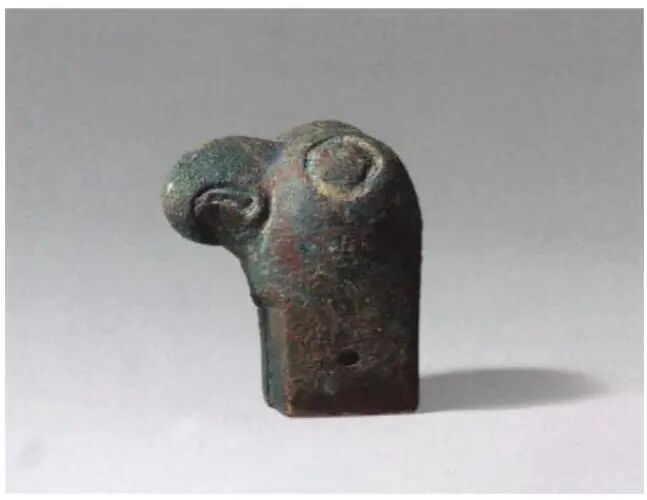
Northwest China, Ningxia and Gansu, circa 4th century BC
Bronze
Provenance: Michael Dunn, New York
This small decorative knob is cast in the shape of a raptor's head. Each eye is represented by a raised bump encircled by a circular indentation, while the beak is formed by a long groove with a raised line running along its curve. The socket is rectangular, with a hole on each side for attachment. The object is hollow-cast, bisected lengthwise by a mold line.

![]()
![]()
![]()
![]()
![]()
![]()
![]() Camel-Head-Shaped Horse-Harness Fitting
Camel-Head-Shaped Horse-Harness Fitting
Northwest China, 4th–3rd century BC, tin-plated bronze
Provenance: Formerly in the collection of Lan Lijie; Calon da Collection
This horse-harness fitting is cast in the stylized form of a camel's head viewed in profile. The eyes are rendered as circular protrusions with rounded edges, while the ears appear as elongated ovals featuring central indentations. The slightly parted mouth reveals both upper and lower teeth. The artist captures the camel's essential features, even hinting at its rather disagreeable temperament. The silvery sheen on the surface results from tin plating the bronze with molten tin. A flange is present on the reverse, with a vertical ring positioned between and below the ears and eyes. The plaque was cast using the lost-wax method.
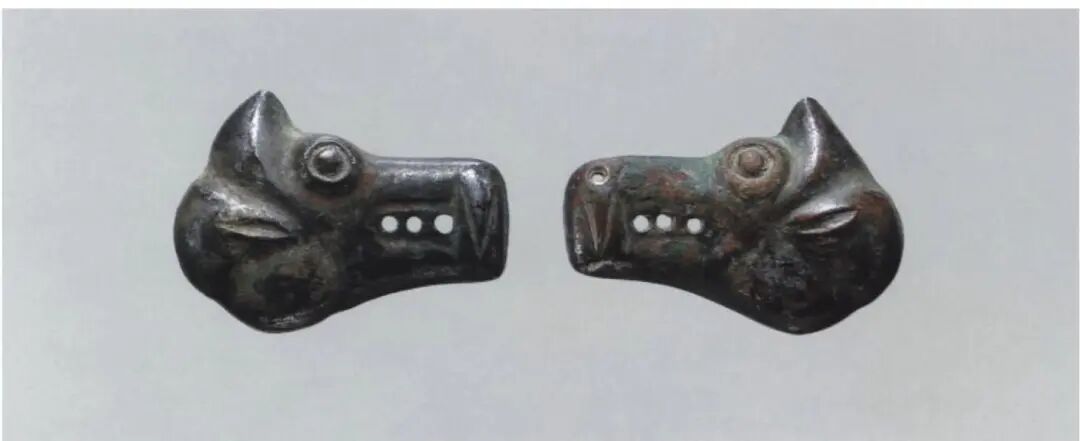
Camel-Head-Shaped Belt Crossings
Northwest China, 4th–3rd Century BC
Tin-Plated Bronze
This pair of belt crossings, each cast in the shape of a camel's head, is stylistically similar to No. 14. The eyes are represented by circular protrusions surrounded by raised circular rims. The reverse of each ornament features a square frame on each of four pillars, designed to accommodate the crossed straps of a horse harness. The frames were cast using segmented molds, while the two camel heads appear to have been cast using the lost-wax method, with the belt cross-piece frames welded into position.


